
The Beauty of the Overlooked: Hemlock Woolly Adelgid, Slime Molds, and the Living Saliva of the Forest
Today I’m musing about hemlock wooly adelgid and the role of slime molds. Slime molds are so complex and are an organism so strange, scientists struggle to study the complexity of the ecological role.
But before we talk about how slime molds swim through the forest via saliva, let’s talk about a little insect. For my decades as a forester and arborist, I have always been told to be dismissive to hemlock woolly adelgid as a serious threat to western hemlocks (Tsuga heterophylla) because it is native and the widespread catastrophic mortality like that seen in other places has not historically occurred here. By comparison, the balsam wooly adelgid killed stands of eastern hemlock forests in an aggressive and detrimental manor. In the Pacific Northwest however, a decline to western hemlocks across the region is attributed to drought stress, warming temperatures, altered snowpack, soil compaction, urbanization, fragmented root zones, and changing hydrology.
It is thought, native adelgids have coexisted with western hemlocks for thousands of years under cool, moist forest conditions, but logging and cities change that long-standing equilibrium. In ecology, beneficial or tolerable relationships can become harmful when conditions change. It is possible that native adelgid populations, fungal associates, or related microbial systems may now be contributing to fungal water stress in hemlocks in subtle ways not yet fully recognized by any current urban forest management models.
Based on moving hundreds of yards of arborist wood chips by hand and based on knowing what tree had been harvested to be converted into those chips, I believe there is a connection between slime molds, hemlock wooly adelgid and western hemlock wood chips that should be investigated further.
What do we really know about the role of slime molds? Is it beneficial or harmful, collaborative or combative? I commonly find dog vomit slime mold (Fuligo septica) grows on western hemlock wood chips as they decay. How did it get there?
In an era where forests are stressed by climate change, drought, invasive species, and biodiversity loss, studying these strange organisms may reveal overlooked ecological processes to help urban forests thrive. Slime molds are essentially predators on fungus. But, what if a once beneficial relationship, such as getting a little bit inoculated with an anti-fungal agent, has shifted under urbanization stressors?
The Hemlock Woolly Adelgid: More Than a Pest Story
Some people have heard of the balsam woolly adelgid because it is a destructive invasive insect in the eastern United States. Those invasions have transformed entire landscapes by killing eastern hemlocks, causing stand mortality, altering stream temperatures, wildlife habitat, and nutrient cycles.
Western North America has its own native adelgid species associated with western hemlock (Tsuga heterophylla) and mountain hemlock (Tsuga mertensiana). Unlike the catastrophic eastern invasion, native Pacific Northwest adelgid populations are thought to have integrated into long-evolved ecological systems. Their interactions with native predators, fungi, microbes, and climate conditions represented a tolerable predatory relationship rather than an ecological disaster.
Could the ecological role of native adelgids extend beyond simple herbivory? Using piercing-sucking mouthparts, woolly adelgids tap into nutrient-rich tissues at the base of hemlock needles, drawing from the tree’s stored resources while sheltered beneath their characteristic white wax. That woolly covering may do more than protect the insects: it could trap moisture, intercept spores, host microbial communities, or even create miniature habitat islands for mites and predatory arthropods. I speculate here that these waxy clusters may function almost like ecological nets suspended within the forest canopy, collecting airborne fungal spores, bacteria, and organic particles from the surrounding environment.
Many insects pass materials from plant to plant through the action of piercing-sucking mouthparts. Could slime molds enter into plant cells with the help of insects? I could not find any research on whether hemlock woolly adelgids transmit plant pathogens the way some other piercing-sucking insects do.
But there is plenty of research available online about how plant pathogens are transmitted by insects with piercing-sucking mouthparts because those insects puncture plant tissues and move fluids, microbes, or viral particles between hosts. Well-known examples include:
aphids transmitting mosaic viruses
leafhoppers transmitting phytoplasmas and xylem pathogens
whiteflies transmitting geminiviruses
psyllids transmitting bacterial diseases
In the urban forest of Seattle and surrounding cities, western hemlocks all have some level of wooly adelgid infestation. Western hemlocks are doing poorly in the Seattle area with urban densification. Yet I was just told recently, by a respected industry leader, that there is no relationship between hemlock wooly adelgid infestation and hemlock decline across the region. I simply wonder, yes but what if there is a connection? What if there had been a benefit for the tree to host the insect?
Slime Molds: The Forest’s Living Intelligence
Despite their name, slime molds are not molds at all. They are amoeboid organisms that spend part of their life cycle moving as giant single-celled masses called plasmodia.
One of the most recognizable species is Fuligo septica, commonly known as dog vomit slime mold because of its yellow, foamy appearance. Gardeners often recoil, because it is gross, when they discover it erupting from mulch after rain. But it is one of nature’s most extraordinary organisms.
At one stage of its life, dog vomit slime mold behaves almost like an animal. The plasmodium creeps slowly across logs, bark, leaves, and soil in search of bacteria, fungal spores, and microorganisms to consume. It has no brain, no nerves, and no muscles, yet it can solve spatial problems, optimize nutrient pathways, and navigate around obstacles.
In laboratory experiments, slime molds have even recreated transportation network patterns similar to subway systems and highway layouts. Researchers studying slime molds have demonstrated that they can:
Find the shortest path through mazes
Create highly efficient transport networks
Respond dynamically to environmental changes
Redistribute nutrients internally
Adapt movement based on humidity and light
But perhaps the most fascinating feature is how slime molds move.
The Incredible Movement of a Slime Mold
The slime mold plasmodium moves through rhythmic pulses of cytoplasm flowing back and forth inside its body. Imagine a living blob with internal tides.
The organism contracts sections of itself in waves, pushing fluid through vein-like channels. This hydraulic streaming allows it to glide slowly across surfaces without legs, wings, or cilia.
The movement is astonishingly elegant:
The slime mold extends outward into new territory.
Cytoplasm streams toward promising food sources.
Unused pathways retract.
The network reorganizes itself continuously for efficiency.
This creates a constantly shifting web of living tubes that functions almost like a decentralized intelligence.
Then comes another astonishing transformation.
Once environmental conditions change, often due to drying air, heat, or nutrient depletion, the slime mold stops moving and begins forming reproductive structures. The once-fluid organism hardens into powdery fruiting bodies packed with spores. Time-lapse footage of Fuligo septica reveals a startling reality: the organism visibly pulses, flows, reorganizes, and migrates across bark and wood like a living liquid network. In some recordings, the slime mold transitions from a creeping plasmodium into a drying reproductive structure that releases spores into the air, transforming from mobile predator into dispersal stage within hours.
In essence, the organism shifts from exploration mode into dispersal mode. The same blob that crept across bark like living liquid suddenly transforms into a biological dust cannon, releasing spores into wind currents to colonize new habitats. All we are is dust in the wind is really how this organism disperses. I suspect this transition from mobile predator to dormant disperser may play a much larger ecological role than we currently understand.
The “Predatory” Nature of Dog Vomit Slime Mold
Calling slime molds “predatory” surprises many people, but the term is appropriate in a microbial sense. Dog vomit slime mold actively hunts bacteria, yeasts, fungal spores, and microscopic organic material. It engulfs food particles through phagocytosis, essentially swallowing prey whole at a microscopic level.
Unlike fungi, which digest externally, slime molds physically consume microorganisms. A moving slime mold can reshape microbial communities across a decomposing log or forest floor. As it migrates, it may selectively reduce some bacterial populations while transporting others. It may redistribute nutrients and spores while changing the chemistry of decay itself. Some ecologists increasingly suspect slime molds function as mobile regulators within decomposition ecosystems.
But what if they interact with insects too?
Could Adelgid Wool Harbor Slime Mold Spores?
Hemlock woolly adelgids produce waxy, fibrous coverings that resemble tiny tufts of cotton. These structures trap moisture and airborne particles remarkably well. Could they also trap slime mold spores?
The possibility has barely been explored.
Forests are filled with microscopic airborne life. Spores drift continuously through humidity gradients and air currents. A sticky, moisture-retaining adelgid wool cluster, especially over the surface area of a swaying western hemlock canopy, could theoretically collect and hold microbial propagules, including slime mold spores.
What if adelgid colonies act as:
Spore capture sites
Moisture reservoirs
Microbial incubators
Tiny ecological nodes linking canopy and bark ecosystems
Even more intriguingly, slime molds themselves produce extracellular slime coatings during movement. These mucus-like layers may contain microbial communities or biochemical compounds that affect surrounding organisms. Some researchers have described forest surfaces as coated in complex microbial films, almost a living “saliva” layer spread across bark, moss, insects, lichens, and decomposing wood.
Forest saliva is not (yet) a formal scientific term, I think it properly captures the idea that forests are coated in constantly exchanged biological fluids:
bacterial biofilms
insect secretions
plant and fungal exudates
plant resins and chemical defense molecules
slime mold mucus
microbial metabolites
These materials probably facilitate nutrient transport, chemical signaling, spore adhesion, and microbial cooperation in ways we barely understand.
How Much Do Woolly Adelgids Move From Tree to Tree?
Hemlock woolly adelgids actually disperse quite effectively despite appearing sedentary. The mobile stage is called the “crawler” stage, tiny immature adelgids capable of moving before settling to feed. They spread by wind dispersal during storms, hitchhiking on birds and mammals, human movement of infested materials, and localized crawling from one branch to another.
The Pacific Northwest Is a Perfect Living Laboratory
The wet forests of the Pacific Northwest offer ideal conditions for studying these relationships.
Healthy, mature, western hemlock forests naturally support:
deep moss layers
decomposing woody debris
native adelgid populations
60 to 100 different slime molds
Complex food webs that change through time
Places like the forests around Bothell, the Cascade foothills, and Olympic Peninsula contain countless microhabitats where these interactions are occurring unnoticed.
Citizen scientists, arborists, naturalists, and photographers are often the first to observe the plasmodium because it looks like an unusual ecological phenomenon. But few observations of slime molds within wood, or insect saliva, or in dormant states exist. These systems are difficult to study. Insect saliva and spores operate at microscopic scales.
But modern tools, including environmental DNA sampling, microscopy, microbial sequencing, and time-lapse imaging now make such investigations increasingly possible.
A Call For Curiosity
I would like to remind the reader, you too can be a citizen scientist. Naturalists and ecologists give to science not only through performing massive discoveries, but through routinely asking smaller questions about natural patterns and showing curiosity about your surroundings. The Pacific Northwest is filled with ecological mysteries still hiding in plain sight. Urban mysteries abound in our lives even though our surroundings grow ever more complicated and connected and global in ecosystems we call towns and cities.
Native hemlock woolly adelgids are often dismissed because they are boring and not like their invasive relatives which dramatically dominated headlines. Slime molds are ignored because they appear gross, strange or unattractive, are hard to study and are certainly not charismatic megafauna, like a furry predator, or rare owl. What are ways to assist long lived native tree species in yards and parks in an increasingly human dominated world? Maybe the answers are small in scale and gross and boring?
Why This Research Matters
At first glance, slime molds and adelgids seem obscure. But ecological breakthroughs often emerge because one person cared and groups of people study community level relationships between organisms across space and through time.
Consider how lichens transformed our understanding of symbiosis, or how mycorrhizal fungi revealed underground forest communication networks. What if slime molds are the next forest health and resilience frontier? Slime molds act as fungal and microbial predators. Studying interactions among adelgids, slime molds, microbes, and western hemlock decline would help foresters with understanding more about these ecological relationships.
Researchers studying slime molds have demonstrated that they can:
find the shortest path through mazes
create highly efficient transport networks
respond dynamically to environmental changes
redistribute nutrients internally through pulsating cytoplasmic flow
adapt movement patterns based on humidity, light, and food availability
In laboratory experiments, one type of slime mold has even reproduced transportation network patterns strikingly similar to human-designed subway and highway systems, including the Tokyo rail network. The slime mold continuously reorganizes its vein-like transport tubes, strengthening efficient pathways while retracting less productive ones, allowing the organism to solve spatial and nutrient-distribution problems without a brain or nervous system.
Some papers are:
Nakagaki, T., Yamada, H., & Tóth, Á. (2000). Maze-solving by an amoeboid organism. Nature 407:470.
Tero, A. et al. (2007). A mathematical model for adaptive transport network in path finding by true slime mold. Journal of Theoretical Biology.
Kay, R. et al. (2022). Stepwise slime mould growth as a template for urban design. Scientific Reports.
Awad, A. et al. (2023). A survey on Physarum polycephalum intelligent foraging behavior and bio-inspired applications. Artificial Intelligence Review.
Could Adelgids Theoretically Vector Microbes or Pathogens?
Yes, at least in principle. Hemlock woolly adelgids:
insert stylets into living plant tissues
produce feeding-associated salivary secretions
colonize multiple shoots and branches
and can disperse between trees
Researchers seem to mostly focus on their direct feeding damage rather than any additional pathogen transmission ecology, so this area remains surprisingly understudied.
I think it is biologically plausible that adelgids could:
transport fungal spores externally
alter microbial communities at feeding sites
introduce opportunistic microbes into stressed tissues
or create wounds and physiological stress that favor secondary pathogens
But there is currently little published evidence demonstrating:
viral transmission
slime mold transmission
or a specific pathogen-vector relationship comparable to aphids and crop diseases
Western hemlock forests are far more biologically complex than they first appear. Native woolly adelgids, slime molds, microbial films, fungi, and decomposer communities may all participate in subtle ecological relationships that remain poorly understood despite their potential importance to forest health and resilience. As climate change, drought, and urbanization continue stressing Pacific Northwest ecosystems, studying these overlooked organisms could reveal hidden processes shaping tree decline, nutrient cycling, and microbial biodiversity.
Sometimes the most important discoveries begin with the smallest observations including a bright yellow slime mold slowly crawling across a pile of wood chips before turning into powder and blowing away. After all, somewhere beneath a western hemlock, a giant yellow amoeba is quietly optimizing transportation networks while humans are still stuck in traffic.
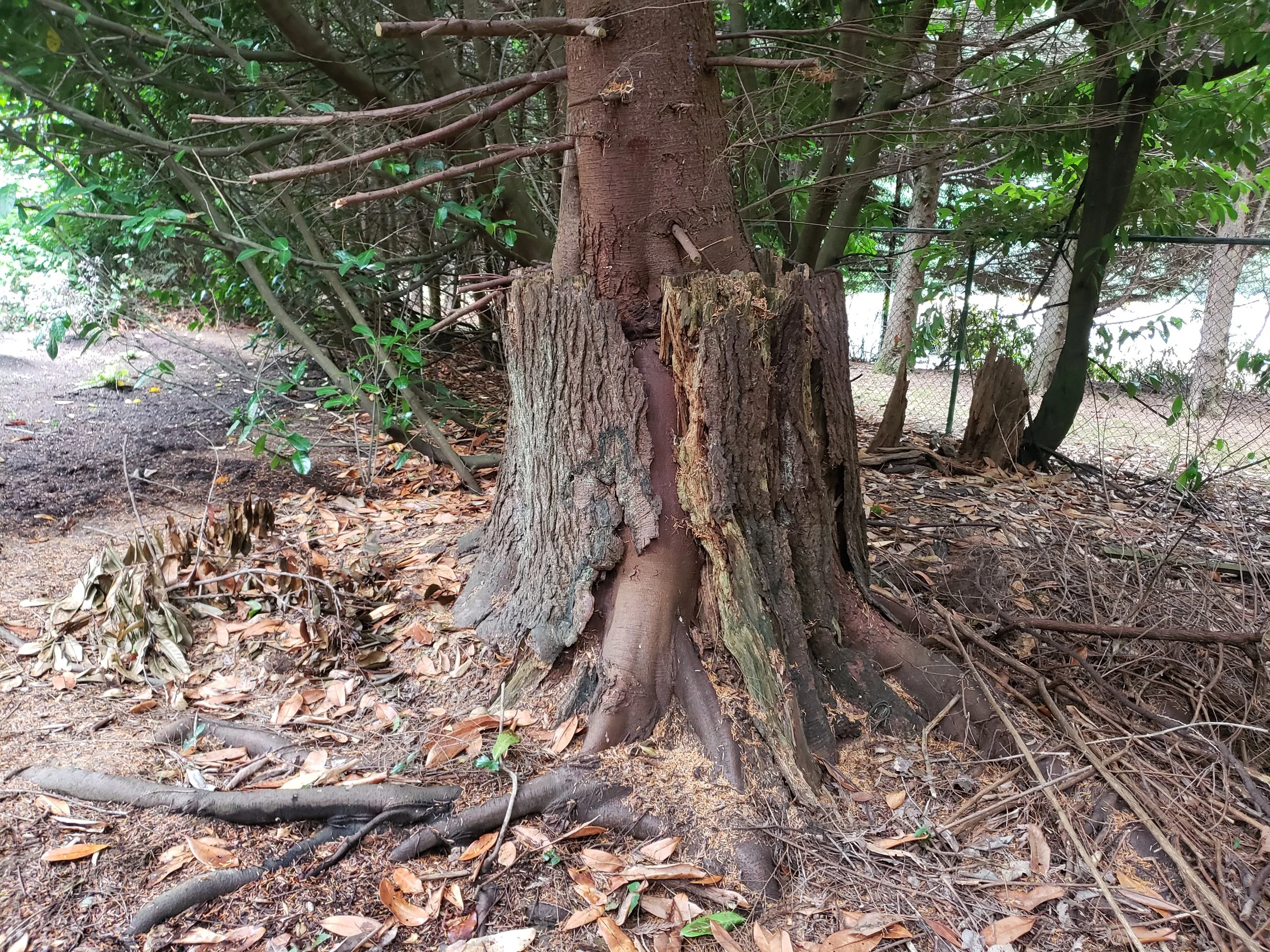
Western hemlock (Tsuga heterophylla) growing out of an old western hemlock stump.
